
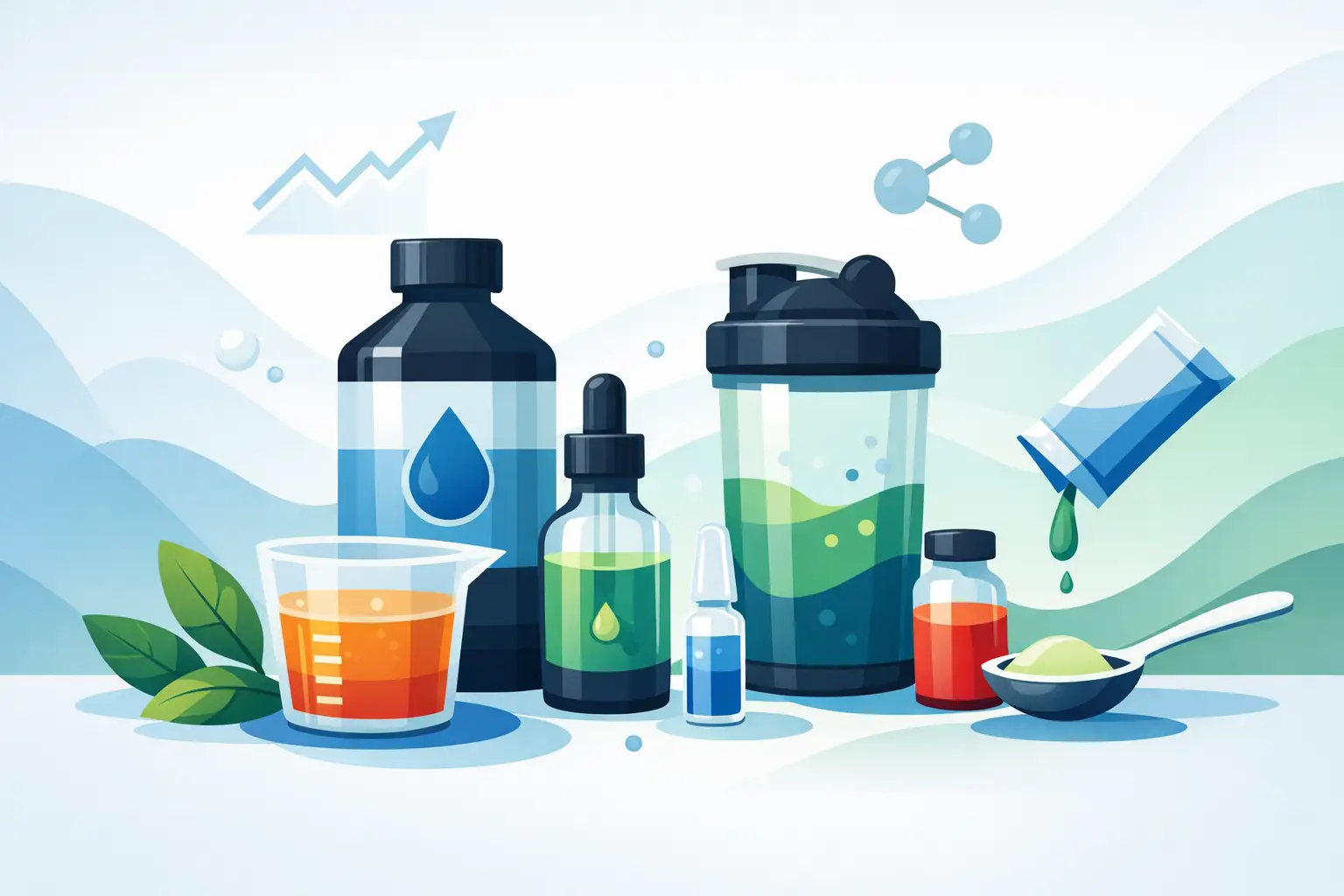
A liquid supplement is not automatically a superior supplement. The best liquid nutrient formats are the ones engineered around the nutrient itself: its stability, its required dose, its intended moment of use and the reality of how consistently it will be taken. For performance-minded people, format is not a cosmetic choice. It is part of the delivery system.
A capsule may offer excellent protection for a sensitive compound. A ready-to-drink shot may make a daily routine more frictionless. Precision drops can make dose adjustment remarkably simple. None wins by default. The intelligent choice begins with liquid logic: match the format to the formula, not the trend.
Why format changes the equation
Liquid delivery has obvious appeal. There is no need to swallow a large tablet, no waiting to mix a powder, and no ambiguity over whether a drink has fully dissolved. It can feel immediate, tactile and compatible with a fast-moving daily rhythm.
Yet liquids introduce a more demanding formulation challenge. Water can accelerate degradation in certain vitamins and botanical compounds. Oxygen exposure, light, heat, acidity and flavour systems can all affect a product’s stability. A premium liquid format therefore earns its place through disciplined formulation, protective packaging and transparent use-by guidance, not merely through an attractive bottle.
Absorption is equally nuanced. A nutrient being dissolved does not guarantee that more of it reaches the bloodstream. Bioavailability depends on the ingredient form, dose, whether it is taken with food, the individual and the wider formulation. Fat-soluble nutrients, for example, may be better suited to an oil-based delivery or consumption alongside a meal containing fat. Water-soluble ingredients may be entirely appropriate in an aqueous formula, provided they remain stable at the stated dose.
The standard to look for is not “liquid versus capsule”. It is whether the format has been designed to preserve the active ingredient and make the intended dose reliably achievable.
The best liquid nutrient formats, compared
Ready-to-drink shots for fixed daily rituals
Shots are built for decisiveness. A single serving, usually in a small bottle, offers a clear dose without measuring, mixing or carrying a shaker. This makes them particularly compelling for nutrients designed around a non-negotiable daily habit or a defined performance window.
Their strength is adherence. A well-designed shot can sit beside a morning coffee, travel in a gym bag or become part of a focused pre-work ritual. For consumers who already make dozens of decisions before midday, that reduction in friction has real value.
The trade-off is flexibility. A fixed shot is less useful when dose requirements vary, and it can become bulky or costly where an ingredient requires a high quantity. Formulators also need to manage flavour, sweetness and preservative strategy without allowing the sensory experience to dominate the nutritional purpose. If a shot tastes engineered solely for mass appeal but provides a token dose, its convenience is performing more work than its formula.
Precision drops for controlled, low-volume dosing
Liquid drops are among the most elegant formats for potent nutrients that work at lower serving sizes. A calibrated pipette or dropper enables more controlled administration than a large drink, while a compact bottle protects a formula from unnecessary volume and packaging waste.
Oil-based drops are often a logical choice for fat-soluble ingredients, although suitability always depends on the specific nutrient and formulation. They can also minimise the need for sweeteners and strong flavours. For users building a considered supplement protocol, drops offer a sense of precision that a one-size serving cannot always provide.
However, precision only exists when the instructions are clear and the dispenser is dependable. Consumers should know whether a serving means one drop, one full pipette or a measured millilitre. They should also understand how to store the bottle, whether it needs shaking and how long it remains suitable once opened. A vague “few drops” instruction is not a high-performance system.
Concentrated liquid blends for multi-nutrient systems
Concentrated liquids occupy the space between a shot and a dropper. Usually supplied in a bottle with a cap measure, they can carry a broader spectrum of nutrients in a serving that remains manageable. This format is useful where a formula is designed as a daily system rather than a single-ingredient intervention.
There is a practical advantage here: a measured serving can integrate into water, a smoothie or a direct daily routine. It also gives brands room to create sophisticated flavour profiles and layered ingredient combinations without requiring consumers to take multiple products.
The challenge is formulation density. More ingredients do not automatically create a better product. Each added active introduces potential compatibility, stability and taste considerations. High-strength minerals can be difficult to formulate pleasantly; botanical extracts may be bitter; some vitamins are vulnerable in water. The best blends are selective, purposeful and supported by serving information that lets the buyer see exactly what is being delivered.
Liquid sachets for portable consistency
Single-serve liquid sachets bring portability to the liquid category. They are a useful answer for commuters, frequent travellers and anyone who wants a controlled serving without carrying a glass bottle. There is no measuring and, unlike a larger bottle, no repeated exposure to air after opening.
For ingredients that hold up well in a sealed liquid environment, sachets can be a highly refined format. They are particularly suited to occasions where routine is disrupted: a long day in the office, a train journey, a hotel stay or a demanding training schedule.
Their limitation is packaging intensity. Individual portions generally use more material than a multi-serve bottle, and users cannot adjust the dose as easily. They are best reserved for formulas where portability and exact serving control genuinely improve the experience, rather than as a novelty wrapper around an ordinary liquid.
What separates a high-performance liquid from a sweet drink
A credible liquid nutrient product makes its design visible. The label should identify the active ingredients, their forms and quantities per serving. It should state how many servings the container holds and offer practical storage instructions. If it contains nutrients with recognised UK health claims, those claims should be used carefully and only in line with the conditions attached to them.
Look beyond front-label theatre. Terms such as “advanced”, “high strength” and “bioavailable” can signal a serious formulation, but they are not proof in themselves. Ask what form of the ingredient is present, how much is supplied, and whether that quantity aligns with the product’s stated purpose. A product that makes broad performance promises while hiding behind a proprietary blend deserves scrutiny.
Flavour matters, but it should not obscure the formula. Sweeteners, acids and natural flavourings can make a daily liquid more enjoyable and may support consistency. Still, a short, understandable ingredient list and an appropriate amount of added sugar are usually more relevant than a dramatic flavour name. Premium does not mean punishingly medicinal, but neither does it mean nutritionally decorative.
Packaging is part of the science. Opaque bottles, amber glass, air-restrictive pumps and sealed sachets can all help protect light- or oxygen-sensitive ingredients. No package eliminates the need for proper storage. A liquid left on a sunny kitchen ledge, in a hot car or beyond its post-opening guidance is not being used as designed.
Choose by use case, not by hype
The most useful question is simple: what must this format do for you? If your priority is a fixed daily serving with no preparation, a ready-to-drink shot may be the right architecture. If you need low-volume accuracy or want to tailor your intake within the label guidance, drops may be more appropriate. If you prefer a broader, measured daily formula at home, a concentrated blend can make sense. If travel and portability are non-negotiable, sachets are often the cleaner answer.
It is also reasonable to choose a capsule when the ingredient needs stronger protection, when a higher dose is required, or when you want to avoid flavourings altogether. Performance optimisation is not loyalty to one delivery method. It is selecting the delivery method that respects the nutrient and supports the routine.
People taking prescribed medicines, managing a health condition, or considering high-dose supplementation should speak with a pharmacist, GP or qualified healthcare professional before changing their regimen. Natural does not mean universally suitable, and more is not automatically better.
For a future-facing wellness routine, liquid supplementation should feel deliberate rather than decorative. Choose a format that protects the formula, communicates the dose with precision and earns a permanent place in the way you actually live.